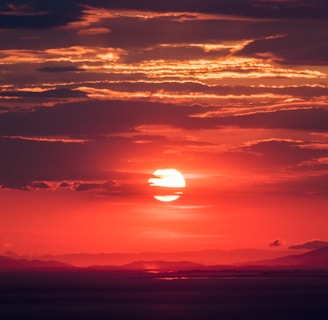
L'uomo che collezionava tramonti 🌅
Ogni sera, poco prima che il sole scompaia dietro le colline, Alberto raggiunge lo stesso punto sul promontorio che domina il mare. Non importa se piove, se il vento è troppo forte o se il cielo è coperto: lui arriva sempre qualche minuto prima del tramonto.
Every evening, just before the sun disappears behind the hills, Alberto reaches the same spot on the cliff overlooking the sea. It doesn't matter whether it's raining, whether the wind is too strong, or whether the sky is cloudy: he always arrives a few minutes before sunset.
Gli abitanti del paese lo osservano da anni e si domandano che cosa trovi di tanto speciale in quel semplice rituale. Alcuni sono convinti che aspetti qualcuno, altri pensano che stia cercando ispirazione per un libro che non ha mai pubblicato. Nessuno, però, ha il coraggio di chiederglielo.
The people of the village have been watching him for years and wonder what he finds so special about that simple ritual. Some are convinced that he is waiting for someone; others think he is looking for inspiration for a book he has never published. However, no one has the courage to ask him.
Un pomeriggio d'autunno, una giovane fotografa di nome Irene decide di rompere quel silenzio. Si avvicina con discrezione e gli chiede se possa sedersi accanto a lui. Alberto annuisce senza dire una parola. Per diversi minuti rimangono entrambi in silenzio, mentre il cielo cambia colore lentamente.
One autumn afternoon, a young photographer named Irene decides to break that silence. She approaches discreetly and asks whether she may sit beside him. Alberto nods without saying a word. For several minutes, they both remain silent while the sky slowly changes color.
«Posso farle una domanda?» dice infine Irene. «Perché viene qui ogni giorno?»
"May I ask you a question?" Irene finally says. "Why do you come here every day?"
Alberto sorride appena. «Per molti anni ho creduto che i ricordi vivessero soltanto nella memoria. Poi ho capito che si nascondono anche nei luoghi, nei profumi e nella luce di certi istanti. Ogni tramonto è diverso dal precedente, eppure tutti mi ricordano qualcuno che non c'è più.»
Alberto smiles faintly. "For many years I believed memories lived only in the mind. Then I realized they also hide in places, scents, and the light of certain moments. Every sunset is different from the previous one, yet they all remind me of someone who is no longer here."
Irene abbassa la macchina fotografica. Per la prima volta da quando ha iniziato a lavorare, sente che nessuna immagine riuscirebbe a raccontare davvero ciò che ha davanti. Alcune storie, pensa, non chiedono di essere fotografate, ma semplicemente ascoltate.
Irene lowers her camera. For the first time since she started working, she feels that no photograph could truly capture what is before her. Some stories, she thinks, do not ask to be photographed but simply to be listened to.
Il sole scompare lentamente all'orizzonte. Nessuno dei due parla. Non perché manchino le parole, ma perché entrambi comprendono che il silenzio, a volte, è la forma più sincera della comprensione.
The sun slowly disappears beyond the horizon. Neither of them speaks. Not because words are lacking, but because they both understand that silence is sometimes the sincerest form of understanding.
Quando Irene si alza per andarsene, Alberto le dice soltanto una frase: «Non colleziono tramonti. Colleziono i pochi istanti in cui riesco ancora a sentirmi vicino a chi ho perduto.»
When Irene gets up to leave, Alberto says only one sentence: "I don't collect sunsets. I collect the few moments in which I can still feel close to those I have lost."
Irene torna a casa senza aver scattato nemmeno una fotografia. Eppure, è il reportage più completo che abbia mai realizzato, perché alcune immagini continuano a esistere anche quando non vengono catturate da un obiettivo.
Irene returns home without having taken a single photograph. And yet, it is the most complete report she has ever created, because some images continue to exist even when they are not captured by a camera.
Useful Vocabulary 📚
🌅 il promontorio — cliff / headland
🌄 il tramonto — sunset
🌊 dominare — to overlook
🤔 domandarsi — to wonder
💭 essere convinto/a — to be convinced
🤫 rompere il silenzio — to break the silence
📷 la macchina fotografica — camera
🧠 la memoria — memory
🌿 il profumo — scent
✨ l'istante — moment
🌅 l'orizzonte — horizon
🕊️ la comprensione — understanding
💔 perdere qualcuno — to lose someone
📖 il reportage — report / feature story
🎯 l'obiettivo — camera lens / objective
Grammar Focus ✍️
1. The Congiuntivo (Subjunctive Mood)
The subjunctive is frequently used after expressions of doubt, opinion, emotion, and possibility.
Examples:
Si chiede che cosa trovi di tanto speciale...
Sente che nessuna immagine riuscirebbe...
Alcune storie chiedono che siano ascoltate. (possible variation)
2. Relative Pronouns
Advanced Italian often links ideas with relative pronouns.
Examples:
Qualcuno che non c'è più.
Gli istanti in cui riesco ancora a sentirmi vicino...
Notice in cui, which means in which / when.
3. The Trapassato Prossimo
Used to describe an action completed before another action in the past.
Example:
Ha iniziato a lavorare.
Ho creduto che i ricordi vivessero...
4. Impersonal and Abstract Language
C1-C2 texts often avoid direct statements and use abstract expressions.
Examples:
Le parole mancano.
Il silenzio è la forma più sincera della comprensione.
Alcune immagini continuano a esistere.
This style creates a more literary and reflective tone.
5. Complex Sentence Structures
Notice how subordinate clauses make the narration richer.
Examples:
Non importa se piove, se il vento è troppo forte o se il cielo è coperto...
Non perché manchino le parole, ma perché entrambi comprendono...
Mastering these structures is essential for reaching an advanced (C1-C2) level of Italian!